How to Solve a Tesla Hardware Engineering Internship Interview Question
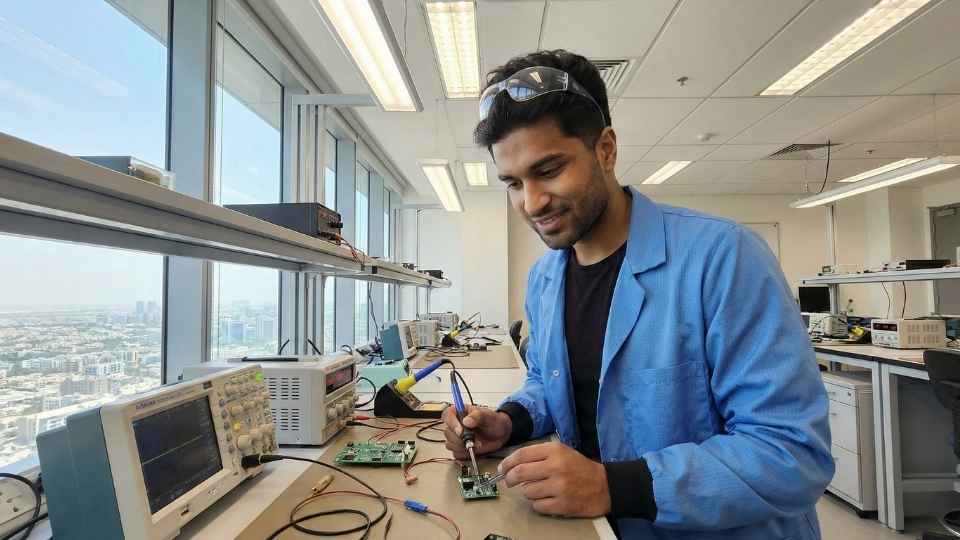
Tesla hardware engineering internship interview questions tend to feel less like school and more like someone dropping a half-working system on your bench. You don’t get a tidy prompt. You get a symptom, a bit of context, and a clock ticking in the background.
A classic Tesla hardware interview scenario goes like this: you’re bringing up an embedded control board. When a motor load steps on, the board resets. You see a brief 5 V droop, and the MCU sometimes browns out, even though the regulator is “rated” for the average load. What do you do?
Why Tesla hardware internship interview questions feel systems-heavy
The trap is answering with a fix before you’ve earned it. “Add capacitance” or “pick a bigger regulator” might end up being right, but if that’s the first thing you say, it sounds like you’re guessing. Tesla hardware engineering interview questions are usually checking whether you can separate three things that candidates mix together: what the system is doing, what the scope is showing, and what the root cause actually is.
“Before I propose fixes, I want to prove where the droop is coming from and what kind of reset this actually is.”
Start with measurement you actually trust
The first move is making sure you aren’t debugging your probe. If you’ve ever looked at a “massive droop” that magically disappears when you shorten the ground lead, you know what I mean. In the interview, it’s worth saying: “I’d probe the 5 V rail close to the MCU, with a short ground connection, and capture a clean good-event and bad-event waveform so I can compare them.”
Right after that, confirm what kind of reset it is. You can literally say: “I don’t want to assume this is brownout until I check the reset cause. If it’s watchdog or a reset pin glitch, the debug path changes.” That’s a small line, but it makes you sound like someone who has actually been burned by assumptions.
Decide if it’s upstream collapse or local PDN
Now you want to answer one simple question: is the problem happening upstream or right at the load? A clean way to talk through this is: “I want the input rail at the regulator and the 5 V at the MCU on the same trigger. If the input droops too, that’s a system-level supply problem. If the input stays stable but 5 V dips at the MCU, that’s local distribution.”
If the input droops when the motor steps, you’re likely dealing with harness impedance, connector resistance, shared power paths, or an input source that can’t support the transient. If the input stays solid but the 5 V at the MCU dips, that points toward local PDN issues like decoupling placement, return path quality, ground bounce, or the regulator’s transient response at the point of load.
“I’m not going to list ten causes. I’m going to put it into two buckets, then measure my way into the right one.”
Fix what you proved, then validate like Tesla
Only after you’ve narrowed the bucket do you talk fixes. If it’s local, you can say: “I’d focus on how current is getting from the regulator to the MCU, where the decoupling actually sits, and what the return path looks like during the transient.” That keeps it grounded in reality instead of sounding like generic advice.
If it’s the regulator behavior, a strong way to phrase it is: “I care less about the average current rating and more about peak transient behavior, current limit mode, and whether the part is hiccuping during the step.”
If it’s upstream collapse, you can say: “Then the fix is probably upstream, meaning input energy storage, impedance through the harness and connectors, and possibly staging the load so the supply isn’t getting slammed.”
Tesla interviewers also like hearing how you’ll validate. A clean closer is: “Once it looks fixed on the bench, I’d validate it at worst-case temperature, worst-case load steps, and across multiple units if I can. I don’t want a fix that only works on my best board.”
What to say in the interview
“I’d probe the 5 V rail at the MCU with proper technique, confirm the reset cause, compare good versus bad captures, decide whether the droop is upstream or local, then choose a fix tied to that evidence and validate it under worst-case conditions.”
That answer is short, structured, and sounds like real hardware engineering, which is exactly what Tesla hardware internship interview questions are trying to pull out of you.
Voltage Learning
Helping hardware engineers ace their interviews