Hardware vs Software Interviews: Key Differences Every Engineering Candidate Must Know
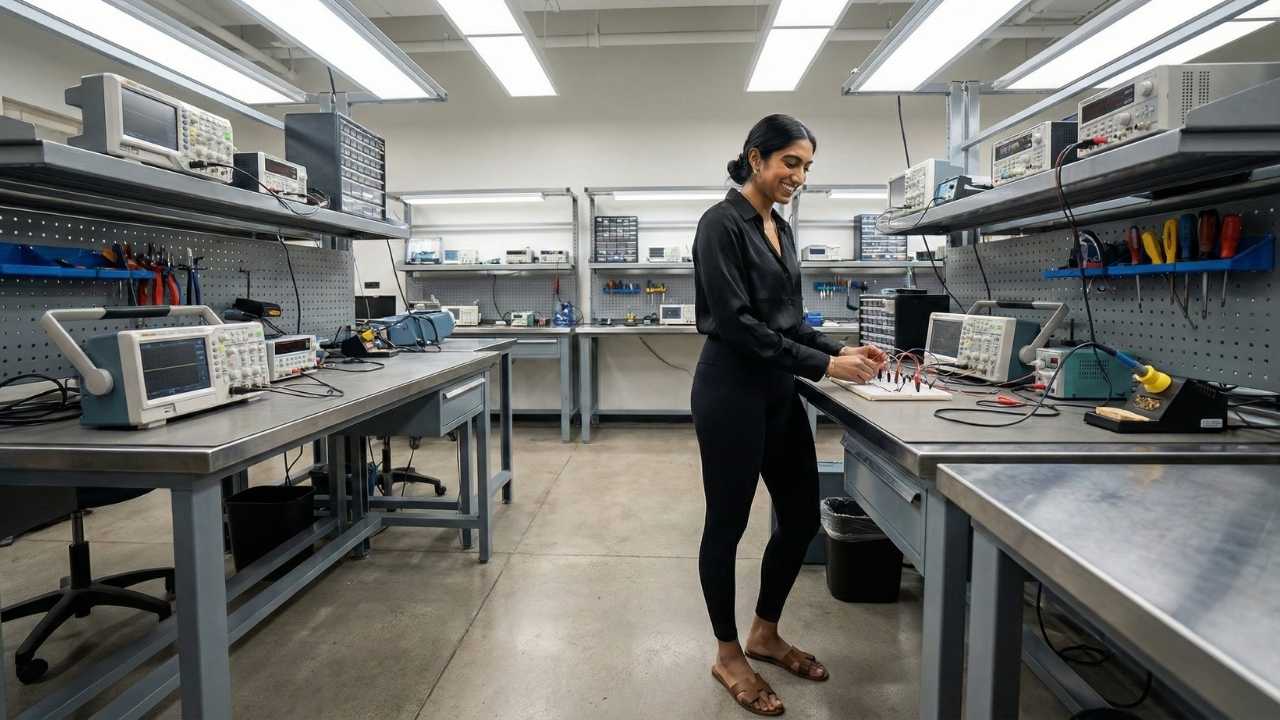
Core Focus: Why Hardware Interviews Test Physical Understanding While Software Interviews Test Abstract Logic
Hardware and software interviews can feel like they belong to two different worlds because the work they predict is fundamentally different. In a hardware engineering interview, the interviewer is usually trying to validate physics-first reasoning: can you translate a schematic, a timing diagram, or a failure symptom into a concrete explanation that respects real constraints like noise, parasitics, power delivery, temperature drift, and manufacturing variation? The best hardware candidates show that they understand the gap between an ideal diagram and a real system. They talk naturally about assumptions, non-idealities, margins, and measurement, because that is how hardware is built and validated in practice. When hardware teams hire, they are often looking for engineers who can be trusted to make decisions that won’t create expensive surprises late in the build cycle.
A software engineering interview is often more about abstraction-first reasoning: can you model a problem cleanly, choose the right data structures, and implement a solution that is correct, efficient, and maintainable? Instead of dealing with voltage droop or metastability, you deal with computational constraints such as latency, throughput, memory overhead, and correctness under edge cases. That doesn’t mean software is less real; it means the interview assesses a different layer of the stack. In strong software interviews, candidates are judged not only on arriving at a solution, but also on how they communicate tradeoffs, how they structure code for clarity, and how they reason about complexity and system behavior at scale. The core difference is what correct means: in hardware it must be correct in the physical world, and in software it must be correct in the logical world under defined constraints.
Question Types Compared: Circuit Analysis, Debugging, and System Design vs Algorithms and Data Structures
Hardware interview questions often cluster around three themes: fundamentals, applied design, and real-world debug. Fundamentals include circuit analysis, transistor-level intuition, digital logic, timing, and common interfaces. Applied design can look like choosing a filter topology, reasoning about an ADC interface, or explaining how you would architect a board or subsystem. Debug questions are especially common because they reveal how you think when information is incomplete. You might be asked why a high-speed interface shows ringing, why an op-amp saturates only in one corner case, or why a clocked system fails intermittently. Interviewers are listening for a structured flow: what you would measure, what you would isolate first, what hypotheses you would test, and how each test reduces uncertainty. This is why hardware interview preparation benefits from practicing story problems rather than only memorizing formulas.
Software interview question types usually separate into algorithm rounds and design rounds, with behavioral communication woven throughout. Algorithm rounds often center on arrays, hashing, trees, graphs, dynamic programming, and string processing, with emphasis on runtime complexity and edge cases. These problems test whether you can decompose a problem, select an approach, and implement a correct solution quickly while explaining your reasoning. System design rounds test whether you can build a scalable architecture: defining APIs, data models, caching strategies, sharding, reliability, observability, and tradeoffs between consistency and availability. Even when software interviews include debugging, it is typically debugging at the code or system level—race conditions, memory leaks, performance regressions, or production incident response—rather than probing signals on a scope. The key insight is that hardware questions often require mapping behavior to physics, while software questions often require mapping requirements to algorithms and architecture.
Whiteboard Expectations: Solving Real-World Electrical Problems vs Writing Clean, Efficient Code
In hardware interviews, the whiteboard is less about producing a polished final artifact and more about making your mental model visible. Interviewers want to see how you reason through a circuit, track signals over time, and choose what to compute versus what to estimate. A strong hardware whiteboard answer often includes a sketch, clear labeling, and a short list of assumptions—then a step-by-step path to a conclusion. For example, if asked about a noisy sensor reading, a strong candidate might separate noise sources into thermal, quantization, and coupling; propose a measurement plan; and discuss mitigation options like filtering, shielding, grounding, or layout changes. The interviewer is watching whether you can keep the system in your head while still being precise about the parts that matter. This is also why hardware interviews reward candidates who can speak in cause-and-effect terms: if we change this component or constraint, here is what we expect to happen and why.
In software interviews, the whiteboard or shared editor is the place where you demonstrate that you can turn reasoning into reliable code. Interviewers expect you to clarify requirements, propose a solution, implement it cleanly, and test it with examples. The difference-maker is often not just correctness, but engineering quality: naming, structure, handling edge cases, and recognizing when the first solution should be improved. Strong candidates narrate their approach: they identify the invariant, outline the algorithm, and then write code that reflects the plan. They also discuss time and space complexity naturally, and they respond calmly to follow-up constraints like make it streaming, reduce memory, or support concurrency. If hardware whiteboards emphasize physical intuition and measurement logic, software whiteboards emphasize algorithmic clarity and implementation discipline. Both are looking for the same skill—structured problem solving—expressed through different outputs.
Preparation Strategies: How to Study for Hardware Engineering Interviews vs Software Engineering Interviews
Effective hardware interview prep is built on depth and realism. Start by sharpening fundamentals—circuit laws, analog blocks, digital logic, timing, and common interfaces—but do it with active recall and problem solving. When you solve a circuit, practice explaining each step as if you were teaching it, because interviewers care about your reasoning more than your final number. Then move into scenario practice: take a real failure mode (for example, an I2C bus that occasionally hangs, a regulator that oscillates, or an oscillator that drifts with temperature) and walk through a structured debug plan: what you would measure first, what tools you would use, and what you would change to isolate the root cause. Finally, prepare your project narrative like a design review. Hardware hiring teams often probe for ownership: what tradeoffs you made, what risks you accepted, how you validated, and what you learned when something went wrong.
Software interview prep is more about breadth, repetition, and speed under constraints. Most candidates improve fastest by mastering a core set of patterns—two pointers, sliding window, BFS and DFS, heaps, intervals, dynamic programming—and practicing enough problems to recognize the pattern quickly. But high performance comes from practicing the full interview loop: clarifying requirements, writing a solution outline, coding without thrashing, testing with examples, and then optimizing. System design prep adds another layer: practice translating vague product goals into concrete architectures, defining interfaces and data models, and reasoning about scaling bottlenecks. A useful way to think about it is that software interviews reward the ability to produce reliable outputs on demand, while hardware interviews reward the ability to reason correctly when reality is messy. If you train your prep to match that reality—repetition for software, realism for hardware—you’ll sound more like a practicing engineer in either interview type.
What Recruiters Actually Look For: Skills, Mindsets, and Signals That Lead to Offers in Hardware and Software Roles
Across companies, hardware interviewers tend to prioritize three signals: trustworthy fundamentals, practical engineering judgment, and a disciplined troubleshooting mindset. Trustworthy fundamentals means you can reason from first principles without getting lost—whether that is analyzing a small-signal model, explaining metastability, or estimating power and timing. Practical judgment means you can talk about tradeoffs in a way that reflects real constraints: performance versus power, margin versus cost, simplicity versus robustness. A disciplined troubleshooting mindset means you don’t guess randomly; you narrow the search space and choose tests that produce decisive evidence. Many hardware teams also care deeply about communication because hardware work is cross-functional by default—design, validation, layout, firmware, and manufacturing all intersect. If you explain clearly, call out assumptions, and show that you can collaborate, you often outperform candidates who only recite facts.
Software interviewers usually look for consistent problem-solving execution, clean coding habits, and an ability to design systems that don’t fall apart under scale. Consistent execution shows up when you solve unfamiliar problems without panic: you ask the right questions, pick an approach, write code that works, and correct issues quickly. Clean coding habits matter because large codebases amplify small mistakes, so interviewers watch for readability, correctness, and thoughtful handling of edge cases. In system design rounds, they look for structured thinking: identifying bottlenecks, choosing storage and caching strategies, reasoning about reliability, and designing for observability. The most valuable insight is that both interview styles are assessing engineer behavior, not just knowledge. Hardware interviews evaluate whether your mental model matches physical reality; software interviews evaluate whether your mental model can be expressed as reliable, efficient software. If you practice showing your model—not just your answer—you give interviewers the evidence they need to recommend a hire.
Voltage Learning
Helping hardware engineers ace their interviews